Electric cars may seem like a relatively new phenomenon, however, it was in 1832 when British inventor, Robert Anderson, created the first electric car.
With more electric cars on UK roads than ever before – the latest data reveals electric cars make up 22.4% of the new car market – many drivers might be asking; can an electric car tow a caravan? The answer is yes, but not all EVs are suitable.
Using our own customer data, we analysed the UK’s most popular touring caravans and matched them with electric vehicles capable of towing them.
Here’s everything you need to know, including towing compatibility, real-world range, and charging stops.
Can Electric Cars Tow Caravans?
Yes – many electric cars can tow caravans, but only if their towing capacity exceeds the caravan’s Maximum Technically Permissible Laden Mass (MTPLM). Larger EVs such as SUVs tend to perform best, while smaller models may not be compatible with heavier caravans.
If you’ve got a caravan and you’re thinking of getting an electric car, it’s also worth noting that your driving range can be significantly reduced when hooked up to a caravan.
Our Methodology
We analysed insurance policy data and EV specs to determine which electric cars can tow the UK’s most popular caravans.
- Top three most popular touring caravan makes & model – This is based on the touring caravans we insure here at The Insurance Emporium. Specifically, it is based on live policies from 01.05.2025 – 30.04.2026.
- EV cars that can tow our most popular caravans – To give a fair assessment we have selected electric cars that are capable of towing lighter caravan models, versus cars that have higher towing capabilities at either the car’s maximum towing capacity, or 85% of its kerb weight, whichever is lower.
- Range – An electric car will have an ‘official range’ that it could be driven for when the battery is fully charged, however, towing a caravan will reduce that range because of its weight. Therefore, we have applied a range reduction of 50% in our estimated towing range.
- Charging stops – Assuming most drivers will stop at a motorway service station, these have been estimated at 45 minutes per stop to achieve up to 80% charge.
- Destination – Being based in York ourselves we decided to make our starting point our home city. To really put the EV cars to the test we decided a location in the South West of England would do us justice, therefore we decided on Pentewan Sands Holiday Park, Saint Austell, Cornwall, PL26 6BT, as it had EV charging points at some of its pitches, which was an added bonus!
The Top Three Most Popular Touring Caravans
Let’s take a look at which caravan models are the most popular with our customers:
1. Swift – Challenger
The Challenger range of caravans is seen as a family favourite, with a series of models to choose from, with a range of two, four and six berth caravans.
MTPLM: The Swift Challenger’s typical MTPLM ranges from 1,435kg to 1,820kg, depending on the specific layout, berth, and whether it is a standard single-axle or twin-axle model.
2. Elddis – Avante
Elddis’ Avante range was previously it’s more affordable range, hence its popularity, with a range of two, four, five and six berth caravans. However, it’s worth noting that in the last year the range has been switched up by a more premium Avante Apex range, with the Whirlwind range now offering a lower price point.
MTPLM: An Elddis Avante’s typical MTPLM ranges from 1,340kg to 1,748 kg, depending on the specific model, berth, and layout.
3. Bailey – Pageant
The first Pageant was produced in 1982 and became one of Bailey’s most successful ranges, spanning over 25 years of construction until it was stopped in 2010. The series 5 to series 7 models range from two, four, five and six berth.
MTPLM: The typical MTPLM for a Bailey Pageant (Series 5 to Series 7) caravan ranges from 1,346 kg to 1,642 kg, depending on the specific model, series year, and the number of berths.
Best Electric Cars for Towing Caravans
Now that we know which caravan models we’re looking to tow, let’s see which electric cars could get us from York down to Pentewan Sands Holiday Park in Cornwall.
- Total distance = 375miles (York, via the M1 – M5 – A30 – Cornwall)
- Average journey time = 7 hours and 30 minutes* (without stopping)
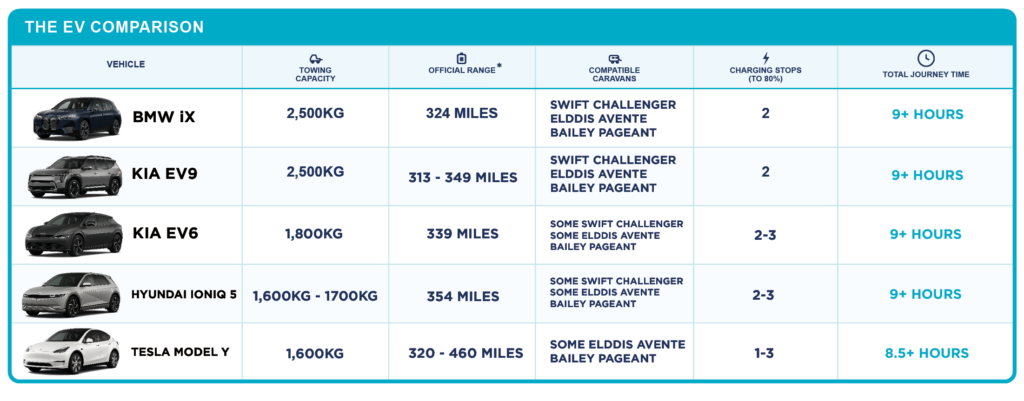
Only two of the five cars selected could tow all of the most popular caravans, while most vehicles would require at least two stops to ensure they have adequate charge to travel the entire distance.
It’s worth noting that even if you’ve got a bigger electric car that has a longer charge range, it’s important to consider taking regular breaks when driving long distances. The highway code recommends that you take a 15-minute break after every two hours of driving.
Top Tips for Towing a Caravan with an Electric Car
The UK has some of the best campsites to choose from, so wherever you choose to take your next caravan holiday, here’s some top tips to remember when driving an electric car:
Avoid range anxiety
We’ve all heard of that friend who drives an electric car and pushes it to its limit before it needs charging, but you can avoid range anxiety by planning in stops along your journey where there are electric charging points, and always have a back-up.
Don’t forget that not all charging bays will accommodate a car hitched up to a caravan, therefore check for trailer-accessible hubs or be prepared to unhitch your caravan to charge your car.
There are plenty of interactive maps which indicate where there are EV charging stations, here’s a few:
Security while charging
If you do have to unhitch your caravan while charging your car, don’t forget to secure a hitch lock or wheel clamp while doing so – you should check you touring caravan insurance policy wording for specific security requirements.
Pick a campsite with EV charging stations
Driving an electric car aligns with the caravanning community ethos of sustainable living and low-impact lifestyle through slow travel. Thanks to EV’s increased popularity, more caravan sites are installing EV charging stations, whether that’s in specific bays or elsewhere on the campsite.
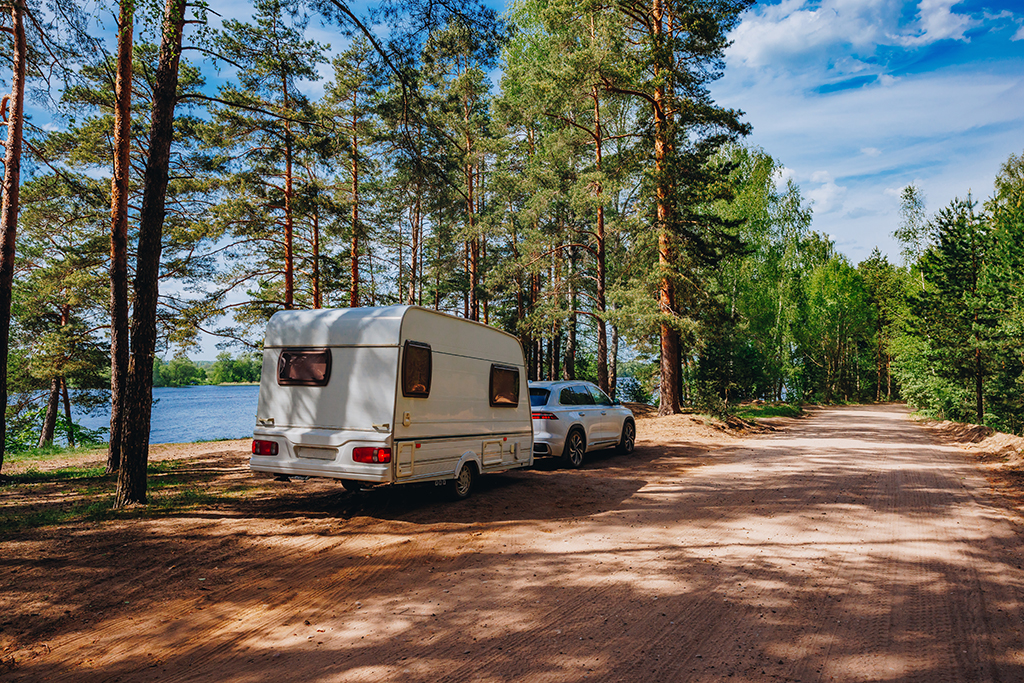
Towing a caravan with an electric car might feel a bit daunting, and if you’re new to caravanning it’s worth finding out more about how to tow a caravan safely and legally.
You can do all the prep in the world, but life on the road can take an unexpected turn so having insurance in place can really help give you peace of mind. We offer three policy types, that you can then add to with a choice of optional benefits. This way you get the insurance that suits you, without paying for what you don’t need. Give us a call or visit our dedicated touring caravan insurance page for more info or simply get a free, no-strings quote.
This blog is in no way sponsored, endorsed, administered by or affiliated with any brands or external websites mentioned in this content.
All content provided on this blog is for informational purposes only. We make no representations as to the accuracy or completeness of any information on this site or found by following any link on this site. We will not be liable for any errors or omissions in this information nor for the availability of this information. We will not be liable for any loss, injury, or damage arising from the display or use of this information. This policy is subject to change at any time.
We offer a variety of cover levels, so please check the policy cover suits your needs before purchasing. For your protection, please ensure you read the Insurance Product Information Document (IPID) and policy wording, for information on policy exclusions and limitations.
*Timings are based on an average speed of 50mph. Please note that when driving while towing a caravan, the legal speed limits are lower than those for a standard car. 60 mph on motorways, 60 mph on dual carriageways, 50 mph on single carriageways, and 30 mph in built up areas unless signs indicate otherwise. Car towing capacity and mileage range comes from a number of sources. The overall time it takes from York to Cornwall is a crude estimate, it does not take into account traffic, weather conditions, and individual driving speeds.