We recently surveyed over 200* horse owners to find out what they knew about vet fees and what mattered most to them, when it came to insurance as well as their horse as they get older.
Common conditions, such as colic and gastric ulcers were estimated to cost £2,000, however 7% of owners opt to not include vet’s fees cover when insuring their horse, despite the risk and costs of these serious and potentially fatal illnesses. And over 95% of policy holders don’t have colic cover** as an optional benefit on their veteran horse policy, despite the increased risk of certain types of colic becoming more prevalent in older horses.
Our full report and results of our survey can be found below.
What horse owners think vs reality
We asked horse owners what they thought the average bill for colic and gastric ulcers would be; the result may surprise you!
Gastric Ulcers
The most common cost of treating gastric ulcers, according to owners, was £2,000 however, based on our claims data, the average claim is £904.
Colic
The most common price owners thought it would cost to treat colic was again, £2,000 however, based on our claims data, colic can range from as little as £379 for mild colic, up to £2,377 for strangulation colic.
While horse owners tend to associate conditions like colic with worst-case scenarios such as surgery, most cases are treated at a much lower cost. However, the unpredictable nature of these conditions means costs can still vary significantly.
It’s also worth noting that both conditions can reoccur, so while the horse may experience mild symptoms the first time, if they have a recurrence the symptoms could be worse.
Colic and gastric ulcers are just two examples of common conditions your horse might require veterinary treatment for over their lifetime. Therefore, for peace of mind, equine insurance might alleviate some of that worry leaving you to focus on your horses’ treatment and recovery. Vet’s fees is an optional benefit to our standard equine cover for horse insurance policies, while vet’s fees for external visible accidental injury only is an optional benefit for our veteran horse insurance policies.
Are horse owners financially prepared?
When the respondents were asked whether they had horse insurance, 16% said they didn’t, while of the 84% that do insure their horses, 7% have opted out of vet’s fees cover. Of those that choose not to have insurance for their horses, 35% don’t have an emergency fund.
These stats closely align with our own internal data*** where 90% of owners have selected vet’s fees as an optional benefit and over 10% have opted out.
We also asked owners if they had searched online to find an estimate for how much it would cost in vets fees if their horse had an accident or illness, and surprisingly, 70% of respondents hadn’t.
What matters most when choosing horse insurance?
We asked horse owners what matters most when it comes to selecting horse insurance, the results were as follows:
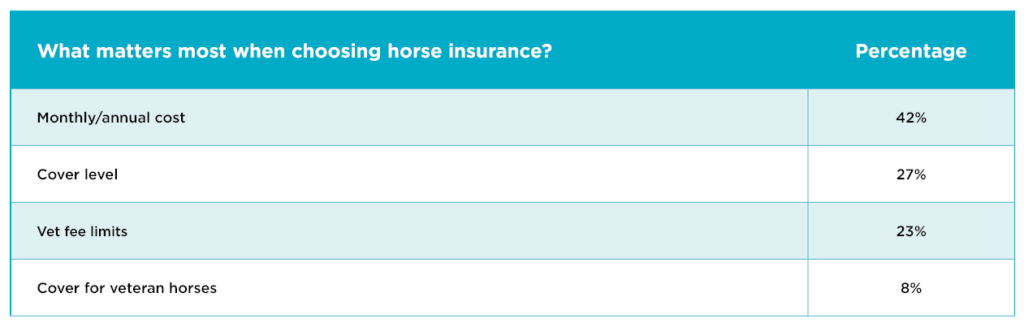
Of those that commented ‘Other’, several cited all the options mattered most to them when choosing horse insurance, while others said monthly costs and cover level.
What about older horses? The rising cost of care in later life

When asked at what age did/would they consider stopping having insurance for their horse as they get older, and just pay for the treatment out of their own pocket, the most common answer was 20 years old.
55% of owners either had an age in mind of when they would stop insuring their horse, or were considering it – citing vet’s fees, the cost of insurance, exclusions, and the horse’s overall health as some of the reasons why they would stop.
Over a quarter (28%) wouldn’t stop their horse insurance, no matter the age, however, less than 5% of veteran horse policy owners**** have chosen colic cover as an optional benefit despite the estimated cost of colic being £2,000. In addition, 9% of owners cited colic as something that worries them most as their horse gets older.
Colic cover – death and vet’s fees is an optional benefit on The Insurance Emporium’s veteran horse insurance, which covers horses over the age of 20 with Death Due to External Visible Accidental Injury Only, Theft Or Straying as standard benefits.
Francis Martin, CEO (Chief Executive Officer) of The Insurance Emporium commented:
We know horse owners are looking to have protection in place for their horses should the worst happen. However, the survey findings also highlight that as horses and ponies get older, despite a concern for potentially fatal illnesses such as colic, owners would cancel their insurance once their horse reaches the age of 20 or have opted out of colic cover.Our veteran horse insurance could still give owners peace of mind, not just with the optional benefit of colic cover; if they’re still being ridden, personal accident, saddlery and tack could also be worthwhile benefits, as well as public liability – which is an optional benefit too, should they make their way out of their paddock and cause an accident.
*These findings are from a survey released by The Insurance Emporium to its marketing contact list of UK adults aged 18+ between March 10th-17th 2026, which resulted in 251 responses from horse owners.
**Colic Cover Vet’s Fees only available for horses aged up to 24 years and 364 days.
***Data provided is based on The Insurance Emporium’s live policies between 1st January 2025 to 31st December 2025 -Horse junior policies with the optional benefit of vet’s fees.
****Data provided is based on The Insurance Emporium’s live policies between 1st January 2025 to 31st December 2025 – Veteran polices with the optional benefit of colic cover.
All content provided on this blog is for informational purposes only. We make no representations as to the accuracy or completeness of any information on this site or found by following any link on this site. We will not be liable for any errors or omissions in this information nor for the availability of this information. We will not be liable for any loss, injury, or damage arising from the display or use of this information. This policy is subject to change at any time.
We offer a variety of cover levels, so please check the policy cover suits your needs before purchasing. For your protection, please ensure you read the Insurance Product Information Document (IPID) and policy wording, for information on policy exclusions and limitations.