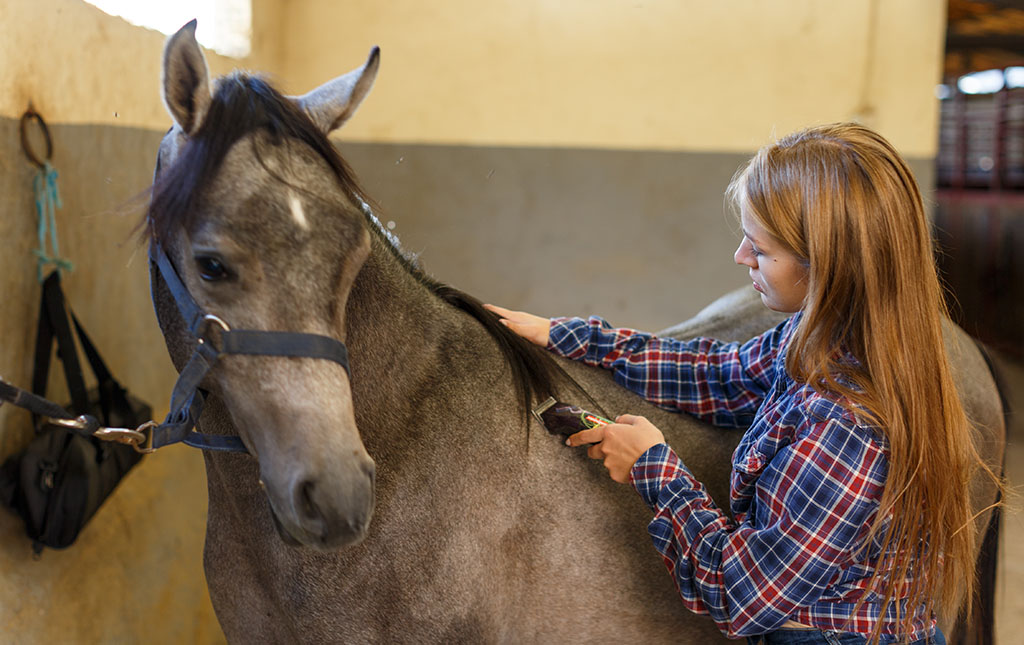
As the days get shorter and we’re starting to feel that autumnal nip in the air, we start to think about how we’re going to look after our horses during the winter months. You might also have noticed your horse’s coat start to change and get heavier; this is when your horse’s winter coat develops, something that helps them survive when they’re out in the wild but can cause overheating and sweating when in a different climate to the one their coat was ‘designed’ for.
This is when many horse owners might start to think about clipping their horses, but what does this mean? We’re a family of horse lovers here at The Insurance Emporium – many of our colleagues are horse owners themselves, so we thought we’d take a look at horse clipping; why we do it, what the different types of clips are, etc.
WHAT IS HORSE CLIPPING?
Horse clipping is the removal of the outer layers of a horse’s coat. The practice dates back centuries and historically, horse’s tails and manes were clipped to stop them getting caught in harnesses and weapons on long journeys, and during battles. Medieval knights clipped their horses to display their colours and coats of arms more clearly.
WHY DO WE DO IT?
These days there are more practical reasons for clipping; mainly health, comfort and performance:
- Sweat can get trapped between the layers of a horse’s coat and cause discomfort, so clipping the horse means they’re less likely to get a chill and less likely to pick up health conditions such as colic.
- Clipping can stop your horse from overheating and lets them dry off more quickly after exercise.
- There’s less chance of tack rubbing if your horse has a thinner coat.
- Clipping can help horses with mud fever, rain scald or leg sores, as having less hair means less mud sticks to them.
- Some owners think clipping will improve the condition of their horse’s summer coat.
- Clipped horses can be easier to groom, which can save time, particularly at a time of year when you want to be out as much as possible while there’s still daylight.
- They can look smarter.
WHEN SHOULD I CLIP MY HORSE?
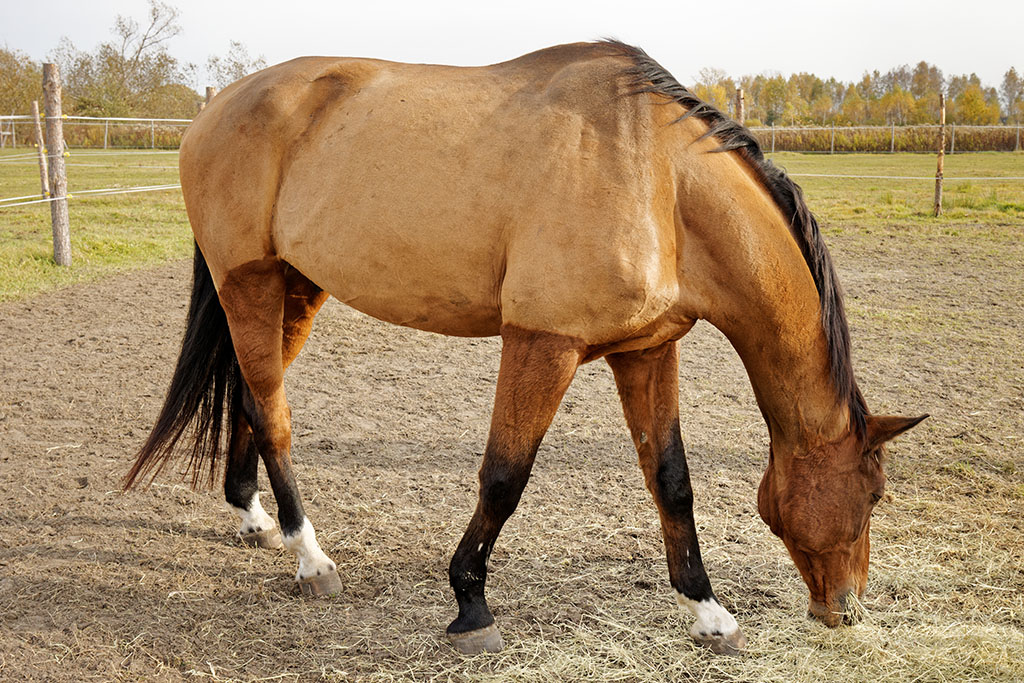
Horses grow their winter coat from September onwards, until the end of February, but it’s best to clip them when their coat has already developed.
CAN I CLIP MY HORSE IN THE SPRING?
You can still clip them in the spring, sometimes the weather warms up faster than they can shed their hair, or they might shed unevenly. Spring can also be a muddy time of year, and a clipped horse will be easier to keep clean. The general rule is to clip them when it’s beneficial to their health, or when the weather doesn’t match their coat; for example, certain horse breeds such as the Fjord horse, will have a coat designed to protect them from a Scandinavian winter – not ideal in a warmer country.
HOW OFTEN SHOULD I CLIP MY HORSE?
Generally, you should aim for intervals of four to eight weeks, but this depends on a few things:
- Where you live
- The weather
- The type of coat your horse has and its growth rate
- Their level of exercise
- Whether they’re stabled or turned out
- The kind of turn out rugs you use

WHAT CLIP SHOULD I DO ON MY HORSE?
Again, this depends on a few factors, mainly the type of work/exercise your horse does, as each clip removes a different amount of hair depending on the workload.
FOR HEAVY WORKLOADS:
- The Full Body Clip – suitable for race and competition horses, this removes all the winter coat from the head and ears down to the legs.
- The Hunter Clip – suitable for eventers, hunters and showjumpers, this removes all hair apart from the head, legs and saddle area.
Things to consider – horses with these clips will be more vulnerable to the cold, so heavy blankets will be needed to prevent them from getting a chill, and turnout might not be possible every day.
FOR MEDIUM WORKLOADS:
- The Blanket Clip – suitable for low-level competition horses, this is similar to the Hunter Clip, but more hair is left along the back, where a blanket would sit.
- The Chaser Clip – this leaves the hair at the back of the neck.
Things to consider – turnout will be weather/temperature dependent and only with the right blankets.
FOR LIGHT TO MEDIUM WORKLOADS:
For horses in light work, these types of clip are used to selectively remove hair in key areas to help them stay comfortable without fully clipping the coat.
- The Trace Clip – this removes the lower half of the horse’s coat, including the belly, leaving the upper half intact.
- The Irish Clip – this removes hair where the horse sweats the most; the neck and behind the elbows.
- The Bib Clip – this removes hair from under the neck and chest.
WHAT IS THE EASIEST CLIP FOR A HORSE?
The easiest clip is the Bib Clip as it’s easy to do and leaves enough of the horse’s coat to keep them warm.
SELECTING THE RIGHT TOOLS
Do some research and if necessary, ask your vet or an experienced horse owner for advice. The type of tools you need will depend on the type of clip, as well as the type of coat your horse has. For example, horses with a lighter coat, or who are only having a partial clip, will be fine with a medium-duty clipper, whereas a horse with a denser coat who needs more frequent clipping, might need something a bit more heavy-duty. For delicate areas and finer details, a cordless trimmer might be the best option.
PREPARING YOUR HORSE FOR CLIPPING
- Clipping should be a positive experience for your horse, so if they’re young or haven’t been clipped before, it’s a good idea to get them used to the sound/sensation before you start. Practise with a small, quiet trimmer and hold it away from your horse at first so they can get used to the sound, before holding against the back of your hand while you stroke your horse; it will feel the sensation through your hand.
- When you start clipping them, go with the direction the hair grows at first, and use long strokes. It’s a good idea to have someone with you to help keep your horse calm, ideally someone who’s got experience of clipping horses.
- A dirty coat can damage the blades of your tools, so make sure your horse has been bathed and dried properly a day or so before you plan to clip them.
- It’s worth remembering that while clipper oil can help the clipper work more efficiently, some horses are sensitive and can develop a rash, so it’s a good idea to do a patch test beforehand.
POST CLIP CARE
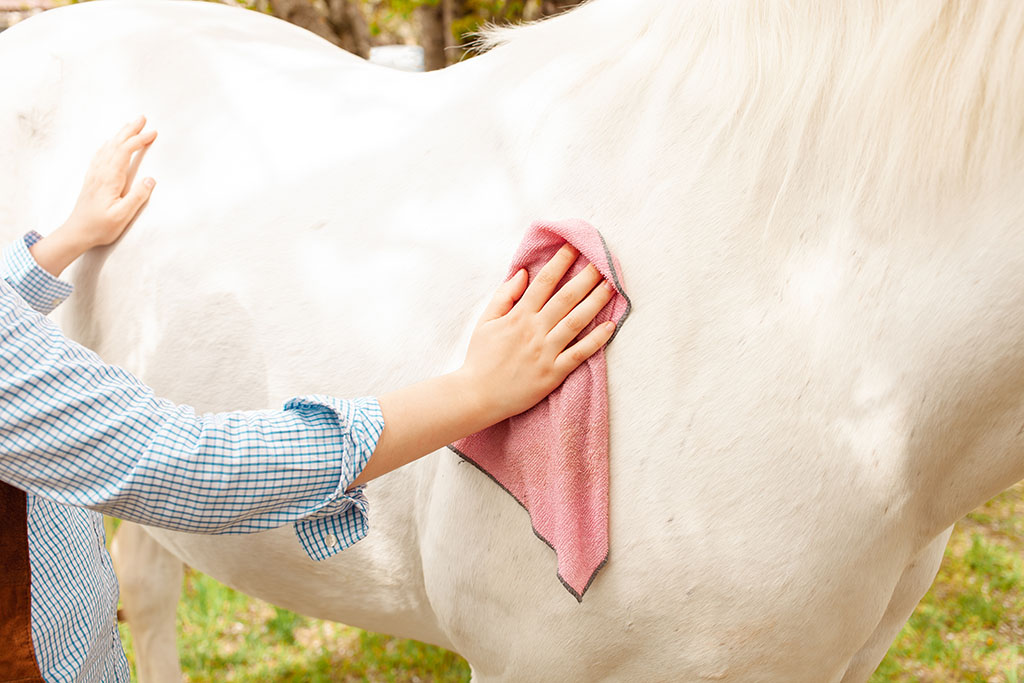
After clipping, monitor the weather/temperature and adjust your horse’s blanket weight accordingly to make up for the loss of their natural insulation. Wipe your horse with a hot cloth with a bit of no-rinse shampoo on to remove any remaining grease and hair; doing this regularly will help keep their coat shiny.
OTHER THINGS TO REMEMBER
- Be aware that a horse’s skin will be more exposed after clipping, so any visible pink skin may need UV protection.
- Work on large areas first, they’re less fiddly (and less ticklish for your horse!), so less likely to agitate the horse.
- Always keep one hand on your horse, it will reassure them and you’ll be able to assess their body language.
- Stop every five minutes to brush hair from the tools, cool the blades and apply clipper oil, as well as checking how your horse is coping.
- Be aware of your own safety at all times; however calm your horse is, they can still kick and react unexpectedly.
- Use your hand to cover their ears/eyes/nostrils when clipping around them and hold their forelock out of the way in case your horse moves suddenly.
- Wear overalls, preferably waterproof ones as the hair won’t stick to those.
- Get a stool.
- Don’t trim whiskers, eyebrows or lashes as they all help with your horse’s spatial awareness.
- When clipping near the eyes remember to point the blade away from the eye.
- Take your time.
Clipping is a personal choice, and you have to decide whether it’s right for you and your horse; our horses are special to us, and we want what’s best for them. This is why we always recommend looking at horse insurance; Our policies start with one standard benefit; Death, Theft or Straying and you get to choose the rest of the benefits, so you end up with a policy that suits both your horse, and your budget. For our more senior horses, our veteran horse insurance covers horses over 20 and comes with Death due to External Visible Accidental Injury Only, Theft or Straying as standard, that again you can tweak to make it your own. Have a look at the website, or give us a call, and get a free, no-strings quote.
Not all horse activities intended for the type of use mentioned in this blog are eligible for every type of insurance, and some may be excluded from coverage altogether.
This blog is in no way sponsored, endorsed, administered by or affiliated with any brands or external websites mentioned in this content.
All content provided on this blog is for informational purposes only. We make no representations as to the accuracy or completeness of any information on this site or found by following any link on this site. We will not be liable for any errors or omissions in this information nor for the availability of this information. We will not be liable for any loss, injury, or damage arising from the display or use of this information. This policy is subject to change at any time.
We offer a variety of cover levels, so please check the policy cover suits your needs before purchasing. For your protection, please ensure you read the Insurance Product Information Document (IPID) and policy wording, for information on policy exclusions and limitations.